Bokmal vs Nynorsk — What Norway's Two Written Languages Mean for Your SEO Strategy

Norway uses two official written standards: Bokmal (used by roughly 85% of the population) and Nynorsk (used by 15%, concentrated in western Norway). For SEO purposes, Bokmal is the primary target for most international companies — but ignoring Nynorsk means missing a meaningful segment in regions like Bergen, Stavanger, and western Norway.
This is one of the most commonly overlooked dimensions of Norwegian SEO. Most international brands either do not know about the distinction or assume it does not matter for search. In practice, it affects keyword strategy, content positioning, and how Google.no evaluates language relevance for Norwegian queries.
The two written standards of Norway
Norway is linguistically unusual among European countries. Unlike countries where dialect differences exist primarily in spoken language, Norway has two officially recognised written standards with different grammar, spelling, and vocabulary.
Bokmal (literally “book language”) is the dominant written standard. It developed from Danish and is used in national media, government communications, business writing, and the majority of online content. When Norwegian companies publish web content, they almost always publish in Bokmal. When Norwegian consumers search online, they search in Bokmal.
Nynorsk (literally “new Norwegian”) developed in the 19th century to represent a Norwegian-native linguistic identity distinct from Danish influence. It is used by approximately 15% of the Norwegian population as their primary written form, concentrated in western Norway — particularly in regions like Bergen, Stavanger, and the counties of Sogn og Fjordane and Møre og Romsdal.
The two standards are not dialects of each other. They are separate written systems with different grammar rules and different vocabularies for some common words. A piece of content written in Nynorsk does not automatically target Bokmal searches, and vice versa.

What this means for Google.no
Google.no processes Bokmal and Nynorsk as related but distinct language variants. This has two practical SEO implications:
Bokmal keywords and Nynorsk keywords can return different SERPs. For some queries, the same concept expressed in Bokmal and Nynorsk returns overlapping results. For others — particularly queries where the word forms differ significantly — the SERPs diverge. A page that ranks well for a Bokmal query may not appear for the Nynorsk equivalent, and vice versa.
Content language signals matter for geographic relevance. Google.no uses language signals — including Bokmal vs Nynorsk — as part of its evaluation of local relevance. For brands targeting specific Norwegian regions, Nynorsk content can provide a relevance advantage that Bokmal content alone does not.
The practical decision for international companies
For most international brands entering Norway, the Norwegian SEO language decision is straightforward: build in Bokmal first.
Here is the reasoning:
Bokmal captures 85% of Norwegian written language use. This includes the vast majority of B2B decision-makers, e-commerce shoppers, and professional services buyers that international companies are typically targeting. Bokmal keyword research, Bokmal content strategy, and Bokmal on-page optimisation covers the national Norwegian market effectively for most categories.
Nynorsk becomes a consideration when:
- You are specifically targeting western Norwegian industries (shipping, aquaculture, energy, Bergen financial sector)
- Your product or service has a cultural or regional specificity that maps to Nynorsk-dominant areas
- You have achieved Bokmal rankings and want to expand into the remaining 15%
Adding Nynorsk content to an existing Bokmal strategy is a well-defined expansion — not a foundational requirement for Norwegian SEO.
The mistake most brands make
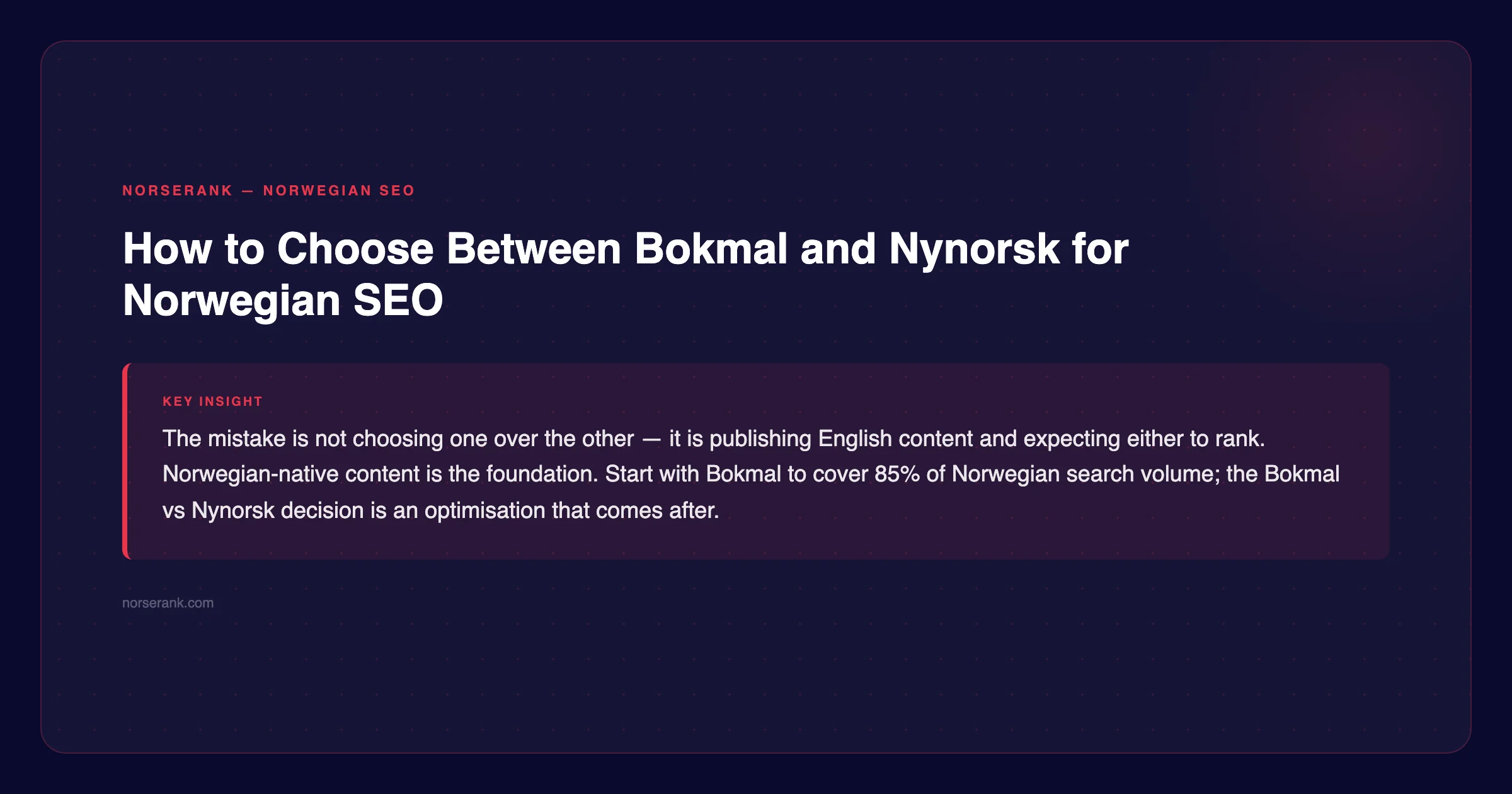
The mistake is not choosing Bokmal over Nynorsk. The mistake is publishing English content and thinking either standard is covered.
Norwegian SEO does not require you to choose between Bokmal and Nynorsk in the early stages. It requires you to choose between English content (which ranks for neither) and Norwegian-native content (which ranks for the standard you build in).
The Bokmal-vs-Nynorsk decision is a nuanced optimisation that comes after you have established a Norwegian content foundation. The more pressing decision is whether your content is Norwegian-native at all.
The regional opportunity in Nynorsk
For brands where western Norway is commercially significant, Nynorsk content creates a genuine ranking opportunity. The Nynorsk-dominant regions are home to major industries: Bergen is Norway’s second city with a large financial and shipping sector. Stavanger is the centre of Norway’s oil and energy industry. Sogn og Fjordane produces significant agricultural and aquaculture volume.
If your target customer is a shipping company in Bergen, an energy firm in Stavanger, or a rural food producer in western Norway, Nynorsk content is not a vanity consideration — it is a credibility signal in a market where being perceived as a genuine Norwegian voice matters more than most international brands expect.
Summary for Norwegian SEO strategy
- Start with Bokmal. It covers 85% of Norwegian search volume and all major business centres.
- Consider Nynorsk if you are targeting western Norway specifically or want comprehensive national coverage.
- Do not confuse the decision with the foundation. Both standards are better than translated English content for ranking on Google.no.