Google.no vs Google.com — Key Differences for International Businesses Targeting Norway

Google.no prioritises Norwegian-language content, local domain signals (.no TLD), and Norway-specific user intent patterns that differ from Google.com results. For international businesses, ranking on Google.com for a keyword does not mean ranking on Google.no — they are functionally separate ranking environments with different SERPs, different competitors, and different content expectations.
This is the most surprising insight for US and UK companies entering Norway. They assume that their existing search presence — rankings on Google.com, established domain authority, well-optimised content — gives them a foundation to build from in Norway. In most cases, it gives them almost nothing.
What Google.no actually is

Google.no is the Norwegian country-code version of Google, operating under Norwegian search algorithms, Norwegian spam policies, and Norwegian content relevance evaluation. It is not a filtered view of Google.com — it is a separate ranking computation that happens to use similar underlying infrastructure.
The key distinction: Google.no evaluates Norwegian-language relevance signals that Google.com’s international algorithm does not apply. When you search on Google.no, the results are determined by:
- Norwegian-language content quality: How well does this page’s content match Norwegian search intent for this query?
- .no TLD authority: Does this domain have Norwegian web presence signals?
- Norwegian local relevance: Does this site demonstrate awareness of and relevance to the Norwegian market?
- Norwegian user behaviour: How do Norwegian users engage with this content when they find it?
A US company with strong Google.com rankings has none of these signals — because their content was not built for Norwegian search intent and their domain has no Norwegian local signals.
The SERP difference
The most direct way to understand the Google.no vs Google.com gap is to search the same query on both engines.
Take a straightforward B2B query: a service category + “norway” modifier in English. On Google.com, you might see international agencies, LinkedIn results, and US-based directories. On Google.no, you see Norwegian-language company pages, Norwegian business directories, and Norwegian-native content — virtually none of which appears in the Google.com results.
Now search the same concept in Norwegian on Google.no. The results shift again — now ranking Norwegian-language content that does not appear for the English version of the query.
These are three separate SERPs for the same underlying buyer intent. International companies typically optimise for the first scenario (English, Google.com) and miss the other two entirely.
The five ranking signal differences
1. Language
Google.no strongly prioritises Norwegian-language content. When a Norwegian user searches on Google.no, the algorithm applies a language quality signal that favours content matching the Norwegian written standard the user is searching in.
This does not mean English content cannot rank on Google.no — it occasionally does, particularly for highly technical or global topics. But for commercial queries where Norwegian-language alternatives exist, Norwegian-native content outranks translated English content at the same domain authority level.
2. Domain signals
The .no top-level domain is the strongest Norwegian local signal Google.no evaluates. .no domains require Norwegian organisation numbers or Norwegian personal identification — meaning they signal genuine local presence. Google.no treats .no domains as more locally relevant than .com, .io, or other international TLDs for Norwegian search queries.
A .com domain can rank on Google.no with correct technical configuration. But it starts from a worse position than a .no domain, all else being equal.
3. Local relevance indicators
Google.no evaluates whether a site demonstrates local relevance to Norway. These signals include:
- Norwegian address and contact information
- Norwegian-language content across the site (not just a /no/ subfolder)
- Links from Norwegian websites and directories
- Norwegian business registration signals where detectable
International companies that publish a single Norwegian landing page on an otherwise English-language site send conflicting local relevance signals — and rank accordingly.
4. Norwegian search intent alignment
Norwegian buyers search with different intent patterns than English-speaking buyers. The same purchase journey looks different in Norwegian search — different query formats, different evaluation terms, different comparison language.
Google.no evaluates how well content matches Norwegian search intent signals. Content built for English search intent — even if translated — does not match Norwegian intent patterns with sufficient fidelity to rank competitively.
5. Engagement signals from Norwegian users
Google.no learns from how Norwegian users engage with search results. Pages that Norwegian users click on, spend time on, and return to accumulate positive engagement signals on Google.no. Pages that Norwegian users pass over or bounce from quickly accumulate negative signals.
Translated content that does not resonate with Norwegian users generates poor engagement signals. This compounds into ranking disadvantage over time — even if the initial ranking position was acceptable.
What this means for your strategy
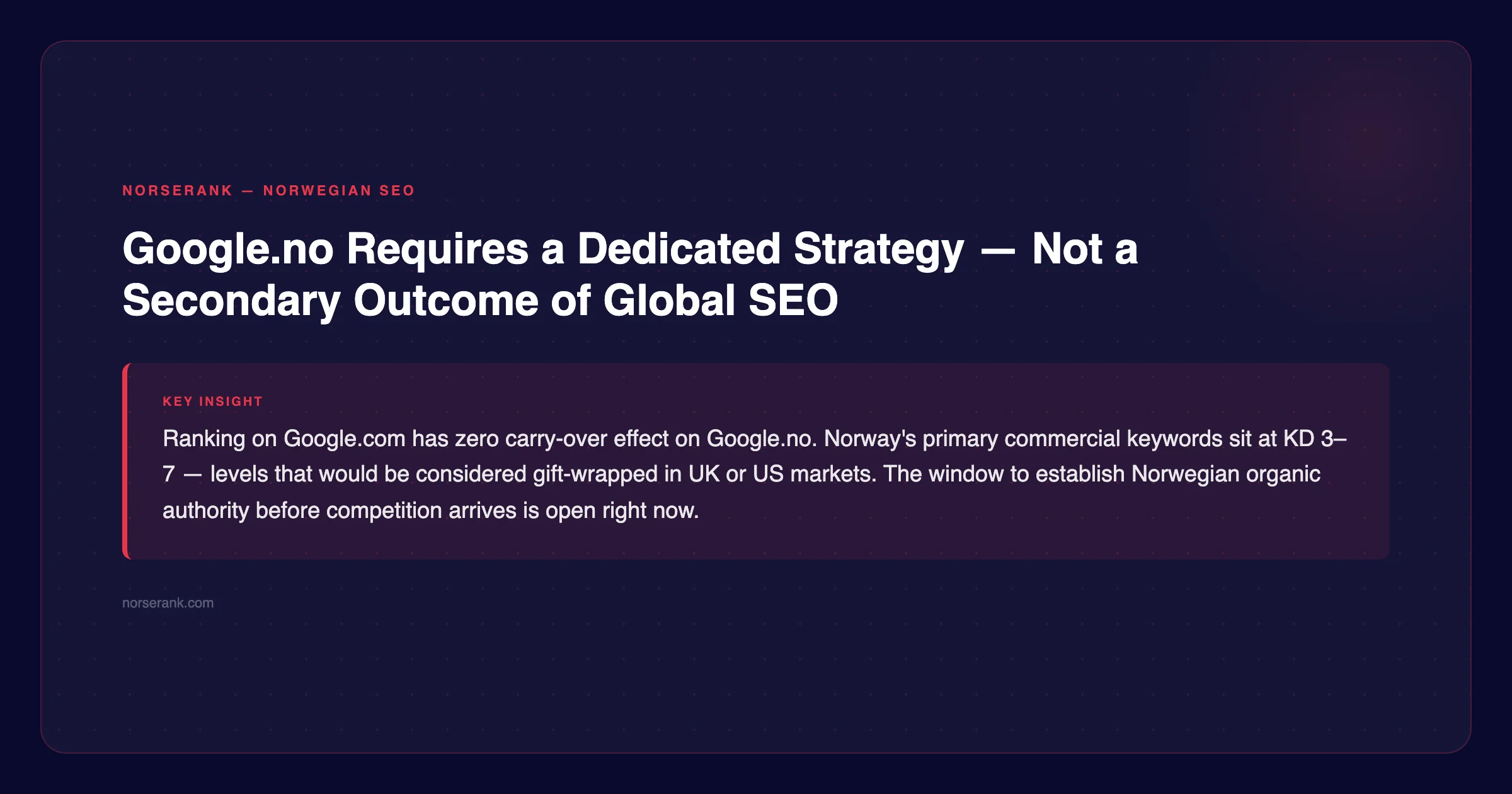
Building search presence in Norway requires treating Google.no as a primary target, not a secondary outcome of global SEO.
That means:
- Separate Google Search Console property configured for Google.no
- Norwegian-native content strategy (not translation)
- .no domain or correctly configured geo-targeting
- Norwegian-language tracking of rankings and performance
The effort involved is not dramatically larger than building an English SEO presence. The competition is dramatically lower. Norway’s primary commercial keywords have keyword difficulty scores in the single digits — KD 3, 4, 7 — levels that would be considered gift-wrapped opportunities in UK or US markets.
The window for establishing Norwegian organic authority before competition increases is open now. International companies that build on Google.no before the SERP fills will compound their advantage for years. Companies that wait until Google.no is competitive will pay much more for the same positions.
Learn how we build Norwegian SEO presence for international businesses.