How Norwegian Consumers Search Online — What International Brands Need to Know

Norwegian consumers use Google.no as their default search engine, searching primarily in Norwegian with distinct query patterns that differ from English-speaking markets. For international companies entering Norway, understanding these patterns — shorter queries, trust-driven evaluation, and preference for Norwegian-language results — is the foundation of any viable SEO strategy.
Most international brands skip this step. They translate their English content, publish it, and wait for Norwegian organic traffic that never arrives. Understanding how Norwegian consumers actually search is what separates brands that rank from brands that do not.
The Norwegian search landscape

Norway has approximately 5.4 million people with one of the highest internet penetration rates in the world. Nearly all Norwegian internet users rely on Google.no as their primary search engine — not Bing, not local alternatives, not Google.com.
This matters because Google.no is not Google.com with Norwegian results. It is a separate ranking environment that:
- Prioritises Norwegian-language content above equivalent English content
- Gives ranking advantages to .no top-level domains for Norwegian queries
- Evaluates local relevance signals that do not exist in international search algorithms
- Returns completely different SERPs for the same query than Google.com
An international brand that ranks on page 1 of Google.com for a keyword can be entirely absent from the first five pages of Google.no for the same search — because they have not optimised for Google.no’s ranking signals.
How Norwegian consumers structure their searches
Norwegian search queries tend to follow patterns that differ from English-language markets in three key ways:
Shorter queries with high implicit intent. Norwegian searches are often more concise than English equivalents. Where an English searcher might type “best project management software for small businesses in Norway,” a Norwegian searcher is more likely to search “prosjektstyring programvare” (project management software) — fewer words, more direct. This means long-tail keyword strategies that work in English markets often miss Norwegian buyers entirely.
Evaluation-heavy research phase. Norwegian consumers research extensively before purchasing or engaging vendors. The evaluation phase generates high search volume around terms like “beste” (best), “anmeldelse” (review), “sammenligning” (comparison), and “erfaringer” (experiences). These query patterns appear across consumer goods, B2B software, and professional services — and they are almost entirely owned by Norwegian-language content.
Trust and verification searches. Norwegian consumers are sceptical of unfamiliar brands and verify before buying. They search for company names alongside Norwegian trust signals — reviews from Norwegian sources, pricing transparency cues, and Norwegian-language customer service indicators. International brands that do not appear in these searches fail the verification step and lose the sale.
The purchasing behaviour difference
Understanding Norwegian search behaviour requires understanding Norwegian purchasing behaviour. Norway is a high-trust, high-expectation consumer market. Norwegian buyers:
- Expect pricing to be transparent and published upfront
- Prefer direct, clear language over sales-heavy copy
- Value local relevance and understanding of the Norwegian context
- Research more thoroughly than most European markets before committing
Content that ignores these expectations — content written for American or British buyers and translated — performs poorly on both ranking signals and conversion signals. Google.no evaluates engagement metrics as quality signals, so poorly-converted content compounds the ranking problem.
The language question
Norway uses two official written standards: Bokmal and Nynorsk. For international companies entering Norway, Bokmal is the correct primary target. It is used by approximately 85% of the Norwegian population in everyday writing, business communication, and online search.
Nynorsk — used by roughly 15% of the population, concentrated in western Norway — is worth considering for brands targeting Bergen, Stavanger, and the western regions specifically. For most national Norwegian SEO strategies, however, Bokmal-first is the right approach.
One nuance: spoken Norwegian varies significantly by region, but written search queries in Norway default to Bokmal regardless of the searcher’s spoken dialect. This means keyword research based on Bokmal written patterns accurately captures search behaviour across most of the country.
What this means for your SEO strategy
Three practical implications for international brands:
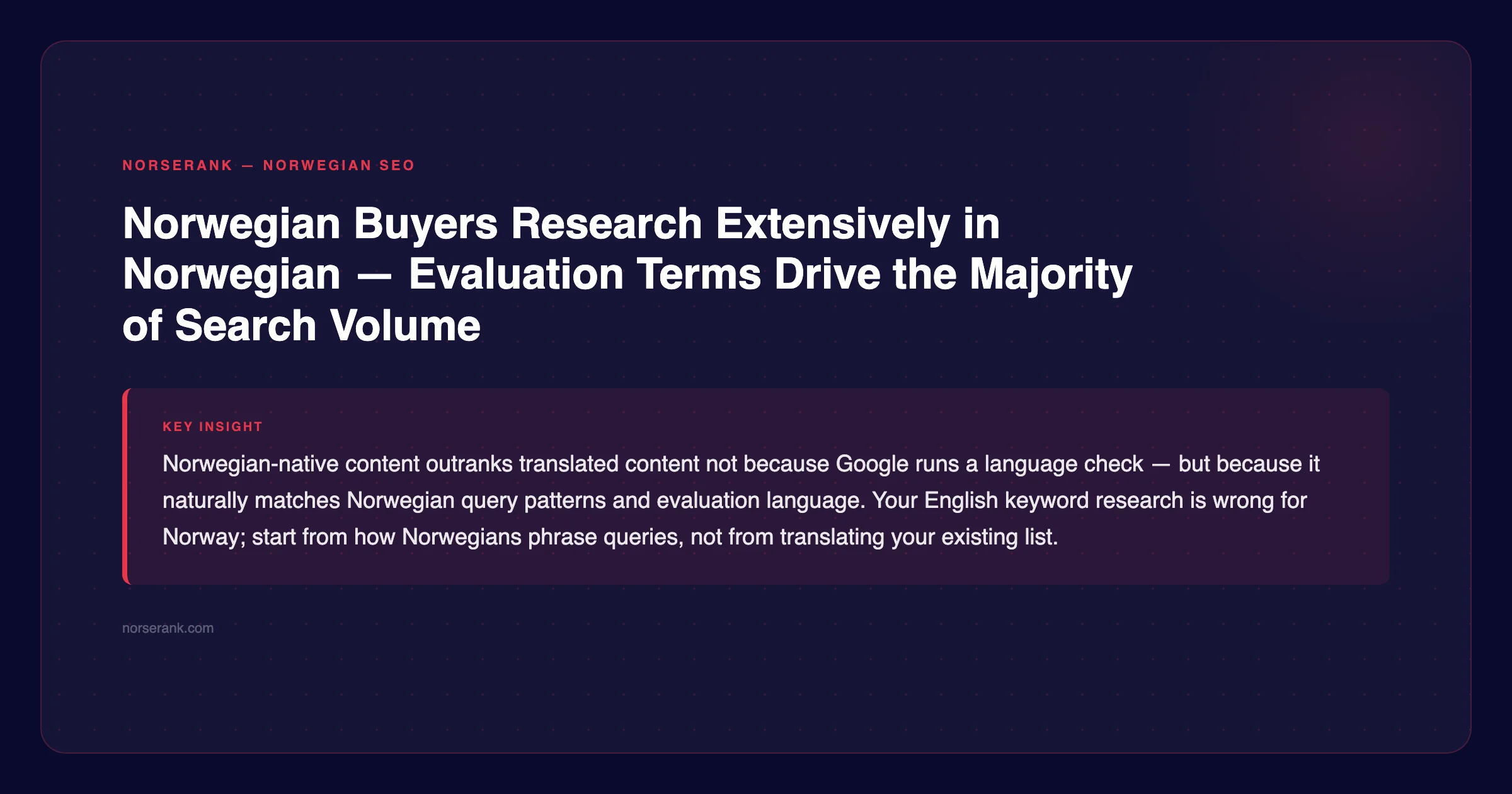
Norwegian-native content outranks translated content. Not because Google runs a language check — but because Norwegian-native content naturally matches Norwegian query patterns, evaluation language, and intent signals that translated content misses.
Your English keyword research is wrong for Norway. The keywords your US or UK SEO agency identified do not map to how Norwegian buyers search. Norwegian keyword research needs to start from how Norwegians phrase queries — not from translating your existing keyword list.
Google.no is a separate priority. Ranking on Google.com has no carry-over effect on Google.no rankings. International companies that treat Google.no as a secondary outcome of their global SEO strategy consistently underperform brands that optimise for Google.no directly.
The Norwegian market rewards brands that invest in understanding it. The competition on Google.no is low enough that Norwegian-native content strategy can produce page 1 rankings in weeks for keywords that would take months in larger markets.
That window will not stay open indefinitely. The brands entering Norway now with Norwegian-native SEO will own the Google.no SERPs before the market gets crowded.
Learn more about how Norwegian SEO works for international businesses.