5 Mistakes US Companies Make With Norwegian SEO (and How to Fix Them)

The most common mistakes US companies make with Norwegian SEO are: translating English content instead of creating Norwegian-native content, targeting American keyword patterns that Norwegians do not use, ignoring Google.no as a separate ranking environment, treating Norway as one of 50 country pages, and hiring agencies that do not speak Norwegian. Each mistake costs months of wasted ranking potential.
Most of these mistakes are fixable in 30 days. The ranking recovery follows within weeks — because the Norwegian search landscape is still uncrowded enough that correct content can move to page 1 faster than almost any comparable market.
Here is how each mistake happens and how to correct it.
Mistake 1: Treating translation as localisation

This is the most common and most costly mistake. US companies translate their English homepage, services pages, and blog content into Norwegian, publish it, and expect Google.no to treat it the same as Norwegian-native content.
Google.no does not. Translated content fails on several dimensions that Norwegian-native content passes:
Search intent mismatch. Norwegian buyers use different search language than English-speaking buyers. A translation that correctly conveys your message in Norwegian will not match the specific phrasing Norwegian buyers use in their searches.
Evaluation language. Norwegian content that ranks includes evaluation terms and comparison language that Norwegian buyers use when assessing vendors. This language does not exist in US-market content and does not emerge from translation.
Cultural positioning signals. Norwegian buyers want to know that you understand their market. Translated content signals the opposite — that you adapted something built for someone else.
The fix: Replace translated pages with Norwegian-native content built from Norwegian keyword research. This does not require scrapping your English content strategy — it requires a parallel Norwegian content strategy built for Google.no from the ground up.
Mistake 2: Using US keyword research for Norwegian markets
US SEO agencies do Norwegian keyword research by translating their existing keyword lists. “B2B marketing agency” becomes “B2B markedsføringsbyrå” — technically correct, essentially useless.
Norwegian buyers do not search the way US keyword research tools suggest they should. Norwegian search queries are often shorter, use different modifier patterns, and concentrate around evaluation language that does not have direct English equivalents.
The practical consequence: US companies invest in ranking for keywords that Norwegian buyers are not searching, while the keywords Norwegian buyers actually use remain uncontested.
The fix: Norwegian keyword research must start from how Norwegian buyers phrase their searches — using Norwegian-language SEO tools, Google.no autocomplete data, and native understanding of Norwegian search language. It cannot be derived from translation.
Mistake 3: Ignoring Google.no as a separate ranking environment
Many US companies assume that their Google.com rankings carry over to Google.no. They do not.
Google.no and Google.com are separate ranking environments with different signals, different competitors, and different SERPs. A domain that ranks on page 1 of Google.com for a keyword can be entirely absent from the first five pages of Google.no for the same search.
The separation happens because:
- Google.no applies Norwegian-language relevance signals that Google.com does not
- .no TLD domains receive local relevance advantages on Google.no
- Norwegian-language content is evaluated against Norwegian search intent rather than international search intent
- Norwegian-language competitors occupy the SERPs that international brands ignore
The fix: Track Google.no rankings separately from Google.com rankings. Configure Google Search Console specifically for Google.no. Build a Norwegian content strategy aimed at Google.no page 1, not at improving Google.com performance.
Mistake 4: Publishing Norway content under a generic subfolder
US companies often publish Norwegian content under URL structures like /no/, /norway/, or as a subdomain like no.company.com. Some publish Norwegian content on their .com domain without any geo-targeting configuration.
Each of these approaches sends weaker localisation signals to Google.no than a .no TLD. The difference is not absolute — companies rank on Google.no without .no domains — but the technical localisation disadvantage compounds other content weaknesses.
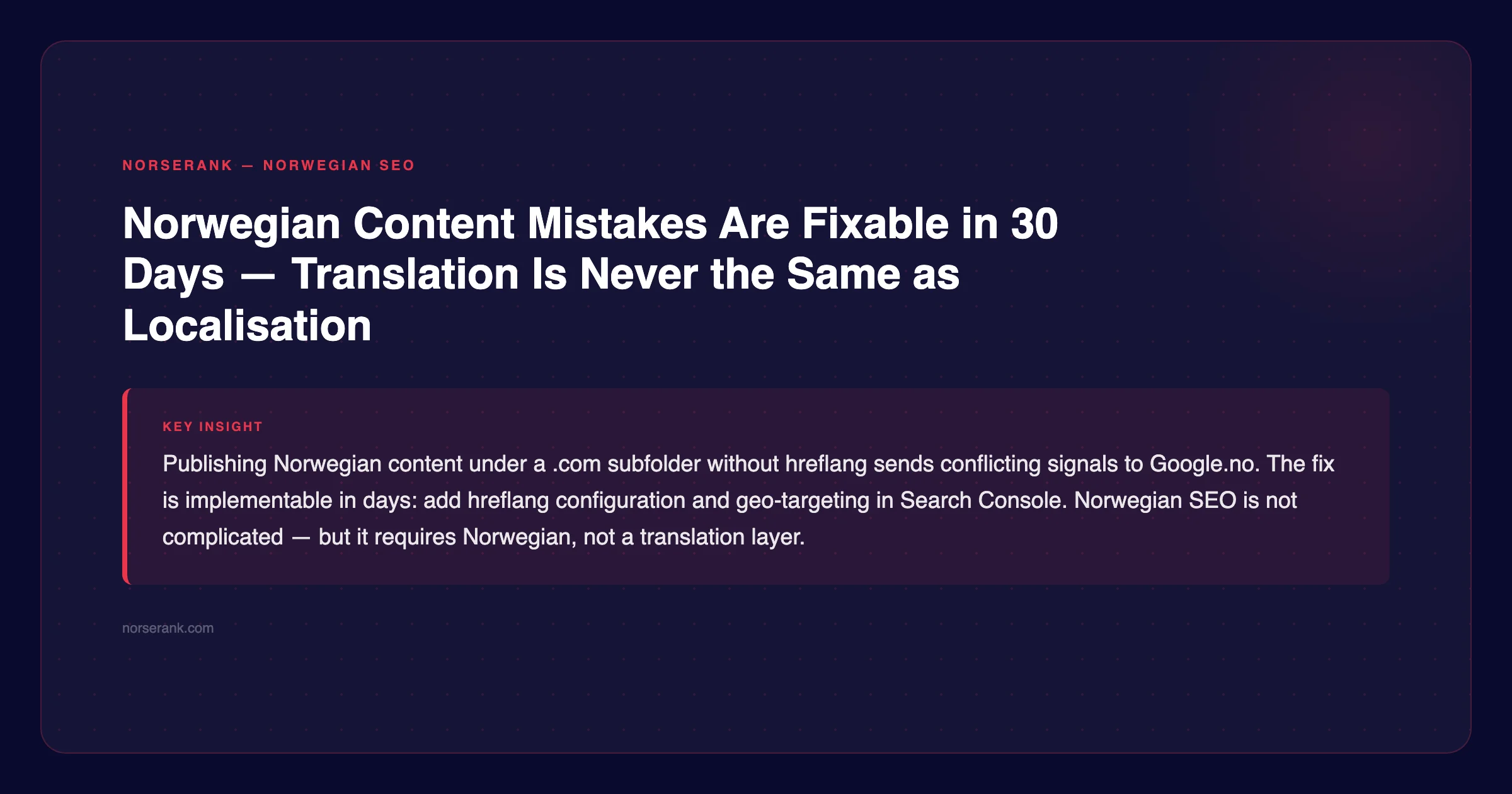
The structural mistake that cannot be undone easily is publishing Norwegian content as a subfolder on a US-focused domain without proper hreflang configuration. This creates conflicting signals: the content is Norwegian, but the domain and site structure signal a US audience.
The fix: The strongest Norwegian SEO foundation is a dedicated .no domain with Norwegian-native content. If that is not possible, hreflang configuration and proper geo-targeting signals in Google Search Console reduce the disadvantage of a .com domain. The hreflang fix is implementable in days.
Mistake 5: Hiring agencies that do not speak Norwegian
This mistake feels obvious stated directly — but it is how most US companies approach Norwegian SEO. They hire a US or UK agency that offers “international SEO” and treat Norway as a market to be served from a standard content template.
The result is exactly what you would expect: keyword research based on translation, content written by non-Norwegian speakers (sometimes via machine translation), and zero understanding of Norwegian consumer behaviour or Google.no ranking dynamics.
Norwegian SEO is not complicated. But it requires Norwegian. A native understanding of how Norwegian buyers search, what content they find credible, and how Google.no evaluates relevance is not something that can be replicated by running content through a translation layer.
The fix: Work with someone who is Norwegian-native and understands Norwegian search behaviour from the inside. This does not require a large agency — it requires genuine Norwegian expertise and a content strategy built for Google.no specifically.
These five mistakes share a common root: treating Norway as a translation of an existing market rather than as a distinct search environment with its own buyers, language, and ranking signals.
The good news is that the Norwegian search landscape is still uncrowded. Most US companies have not fixed these mistakes yet. The brands that do it now will own Norwegian Google rankings before the market gets competitive.
Learn how we help international companies rank on Google.no.